
For many, the simple question “Can I afford this?” is anything but simple. In today’s world, finances are a dynamic, multi-stream puzzle. Consider a typical scenario: You earn $X income bi-weekly, but face monthly bills (mortgage/rent, car loan, utilities). You use 3 credit cards strategically—one for utilities, one for groceries, another for dining—to maximize rewards, but this creates multiple payment cycles and balances. Now, you see a new gadget or need a piece of furniture costing $Y. You could put it on a card, but should you?
Manually figuring this out, especially in a tool like Google Sheets, is a complex exercise in financial forecasting. Let’s break down why.
The Manual Google Sheets Breakdown: A Cascade of Formulas
Creating a true “Affordability Calculator” in Google Sheets requires building a mini-financial model. Here’s what that involves:
1. Income Alignment Problem:
You are paid bi-weekly (26 pay periods/year), but plan monthly. A simple =Income/2 fails due to months with three paychecks. You must either:
- Model Annually: Input
=(X*26)/12to get a true average monthly income. - Create a Date-Driven Calendar: Use formulas like
=IF(MOD(ROW(), 14)=0, X, 0)to simulate bi-weekly deposits across a timeline, then sum by month. This is immediately complex.
2. Expense Categorization & Tracking:
- Fixed Monthly Debts: Housing, car loan. Simple monthly entries.
- Variable Monthly Bills: Utilities, charged to Card A. You must track both the utility amount and the resulting card balance.
- Daily Spending: Groceries (Card B), Restaurants (Card C), Gas, etc. You need estimated averages or must log every transaction to know your true cash flow.
3. The Credit Card Juggling Act (The Core Complexity):
This is where formulas multiply. You need separate sections for each credit card:
- Balance Forward:
=Previous Month's Ending Balance - New Charges:
=SUMIFS(SpendingLog!Amount, SpendingLog!Category, "Groceries", SpendingLog!Month, CurrentMonth)– requiring a detailed transaction log. - Payments: You must decide a payment strategy (e.g., pay off all, or minimum + some). This cell is a manual decision point that affects your cash.
- Interest Calculation: If not paid in full, you need
=(Balance Forward + New Charges - Payment) * (APR/12). This requires knowing each card’s APR. - Ending Balance: The sum of the above, rolling into next month.
4. Calculating Discretionary Cash Flow (The “Can I Afford?” Number):
This is your key metric. It’s not just Income - Bills.
It’s:= (Monthly Income) - (All Fixed Monthly Bills) - (Total Planned Credit Card Payments for the month) - (Estimated Cash Expenses)
This tells you the free cash you could use to pay off a new purchase immediately.
5. Modeling the “What-If” Purchase ($Y Item):
Now you add the $Y item to one of your card balances. This triggers a cascade of updates:
- The chosen card’s “New Charges” increases by $Y.
- Your planned payment for that card likely needs to increase to avoid high interest, reducing your Discretionary Cash Flow for future months.
- You must forecast forward 3-6 months to see: Does adding this payment cause a shortfall? Does it increase interest costs on other cards? Will you have to cut back elsewhere?
The Verdict on Manual Calculation:
While Google Sheets is powerful, building and maintaining this model is time-consuming, error-prone, and static. It requires constant updating, formula auditing, and manual “what-if” adjustments. It’s a part-time job. Your financial picture is a living entity—a static spreadsheet struggles to keep up.
From Spreadsheet Struggle to Financial Clarity: Enter Forecastly
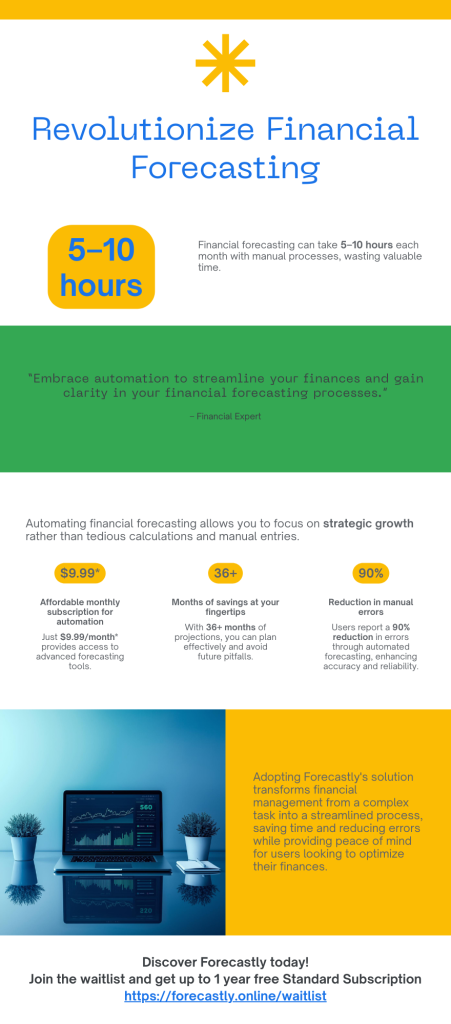
What if you could bypass 90% of that work and get a confident, real-time answer to “Can I afford this?” in seconds? This is the reality with Forecastly.
Forecastly is designed specifically to solve the exact complexity described above. Here’s how it transforms the process:
1. Automatic Financial Picture Integration:
Simply enter your fianacial information like bank accounts, credit cards and recurring transactions. Forecastly instantly aligns your bi-weekly paychecks, identifies your monthly bills, and categorizes your credit card spending. No formula errors. You have an accurate, living model of your cash flow from day one.
2. Intelligent “What-If” Scenario in One Click:
Want to see the impact of a $Y purchase?
- Open the “Scenario Planner.”
- Drag in the item (e.g., “New Laptop – $1,200”).
- Assign it to a specific credit card.
- Instantly see the forecast.
Forecastly doesn’t just show next month. It projects 36+ months into the future, visually illustrating how this purchase affects your card balances, your disposable income each month, and the total interest you’ll pay based on your payment strategy.
3. Smart Credit Card Optimization:
Forecastly understands the juggling act. It can run scenarios to answer:
- “If I buy this, what’s the best card to put it on (based on APR/rewards)?”
- “To avoid interest, how much more do I need to pay on my card next month?”
- “How does this purchase delay my goal to pay down Card B?”
4. Dynamic Safety Net & Goal Tracking:
The app constantly calculates your true discretionary income after accounting for all your commitments and goals (like an emergency fund or vacation). It doesn’t just tell you if you can buy something; it shows you what you’re potentially delaying by making that choice.
Why Forecastly at $9.99/month* is an Investment, Not an Expense
Consider the cost of not using it:
- Time Cost: Building and updating our described Google Sheet takes 5-10 hours monthly. At even a modest value of $20/hour, that’s $100-$200 of your time wasted.
- Financial Cost: A single mistake in your manual forecast—like forgetting a bi-weekly pay period or underestimating interest—could lead to a late payment ($35 fee), increased APR, or credit score harm. The cost dwarfs $9.99.
- Anxiety Cost: The mental load of wondering, calculating, and worrying is exhausting. Forecastly provides financial confidence and peace of mind.
For less than the price of two coffee shop lattes, you get:
- A professional-grade, automated financial forecast.
- Clarity to make spending decisions with confidence.
- A tool that actively helps you avoid fees, reduce interest, and reach goals faster.
- Your most valuable asset: time and mental energy, regained.
Final Verdict: While a dedicated DIY-er can attempt to map their financial maze in Google Sheets, Forecastly is the express lane. It automates the tedious, eliminates the errors, and illuminates the path forward. For anyone managing multiple income streams, bills, and credit cards, the Standard subscription isn’t a cost—it’s a strategic investment in financial health and simplicity. Try it for one month. The moment you answer, “Can I afford this?” in 30 seconds flat, you’ll understand its true value.
Stop calculating, and start forecasting. Your financial clarity awaits.
We are working hard to bring Forecastly alive.
Join the waitlist and receive up to 1-year free standard subscription or keep your free forever basic account!
https://forecastly.online/waitlist
Join now and receive our Guide to Financial Freedom for free
* Monthly Subscription for the Standard plan. Sales Taxes may apply.